An online memorial is not a biography. It is not an obituary, or a tribute written by one person who knew one version of someone's life. At its best, it is something far more complete — a space where many people contribute what they knew, what they remember, and what they want to say, until a portrait emerges that no single person could have drawn alone.
This guide is about how to build that. Not just what to write, but how to gather.
Why one person can't do it alone
The people gathered at a funeral knew your loved one in different ways. The childhood friend holds memories from a version of them that predates everyone in the immediate family. The colleague saw how they handled pressure, how they treated people when nobody was watching. The neighbour noticed the small things — the routine, the kindness, the habits nobody else would have thought to mention.
If the online memorial only reflects what one person remembers, it reflects one chapter. The goal is the whole book.

The digital guest book — more than a signature
A traditional guest book captures attendance. People sign their names and move on. A Memories Digital Guest Book does something different.
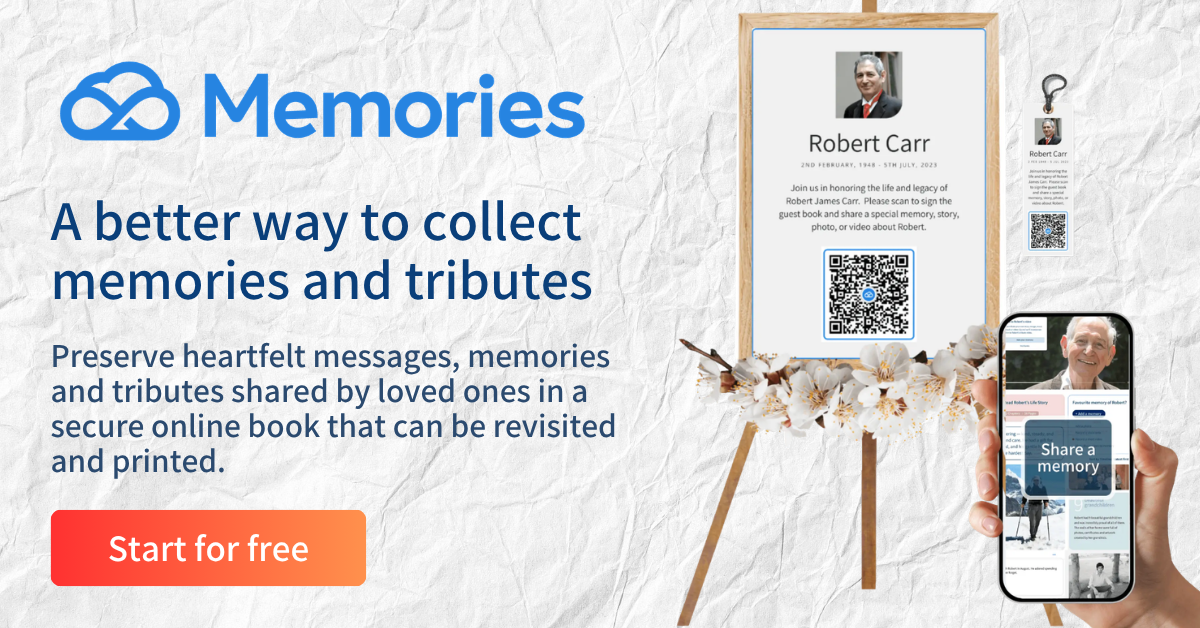
Via a QR code displayed at the service — on the order of service booklet, a printed card at the entrance, or a screen near the door — every guest can leave a message, a photo, or a short video tribute directly from their phone. No app, no account, no friction. Just a moment to say something that might otherwise go unsaid.
And it doesn't close when the service ends. The link can be shared with family and friends who couldn't attend — people in other countries, people who heard the news a week later, people who needed time before they found the words. A message left three weeks after the service can mean as much as anything said on the day.
Every contribution is automatically preserved in the online memory book, exactly as it was written. Nothing gets lost in a drawer. Nothing fades.
Building the online memory book
The Memories Online Memory Book is the private, permanent home for everything gathered. It sits at the centre of the platform and grows over time — not frozen at the moment it was created, but added to as new contributions arrive and new memories surface.
Here's what typically goes into one, and how to gather each element:
Photos and videos
Start by sharing a contribution link with family and friends early — before the service if possible. The most meaningful images are rarely all in one place. A cousin has photos from twenty years ago. A school friend has a video from a holiday. An elderly relative has printed photographs from before anyone else was born.
Asking specifically — "Do you have any photos from her time in London?" or "Do you have any video of him at the workshop?" — produces more than a general request. People have more than they realise, and they need to be asked.
The biography
A written biography gives the memory book its spine — the structured story of a life, from the early years through the chapters that followed. It gives context to the photos and a frame for the stories.
Memories Biography Writer guides families through the process with structured prompts, generating a personalised first draft to shape and edit. It's particularly useful when the blank page feels impossible — which, at this moment, it often does.
Guest book messages
Once the service has passed and the digital guest book has collected its contributions, every message flows automatically into the online memory book. They don't need to be imported or transferred. They're simply there — a permanent record of what people wanted to say about someone they loved.
The tribute video
The tribute video created for the service — photos set to music, gathered from family and friends — lives on in the memory book after the day itself. It is often the most-returned-to part of the memorial in the years that follow.
What makes an online memorial rich
The memorial grows richer with each contribution. A photo added on the first anniversary. A story a grandchild eventually shares. A memory that surfaces years later from someone who saw a post about the person online and wanted to say something.
This is what separates an online memorial from a static page — it is not finished. It is a living record that continues to grow as long as the people who loved the person are willing to add to it.
The Memories Online Memory Book is private and secure, accessible only to the people the family chooses to invite. It has no advertising, no algorithm, no unrelated content. Just the story of one person, told by everyone who knew them.
Starting the memorial
The best time to start is before the service. Even a name, a photograph, and a date gives the digital guest book somewhere to point. Everything else can be added in the days and weeks that follow.
Start for free — no credit card required.